

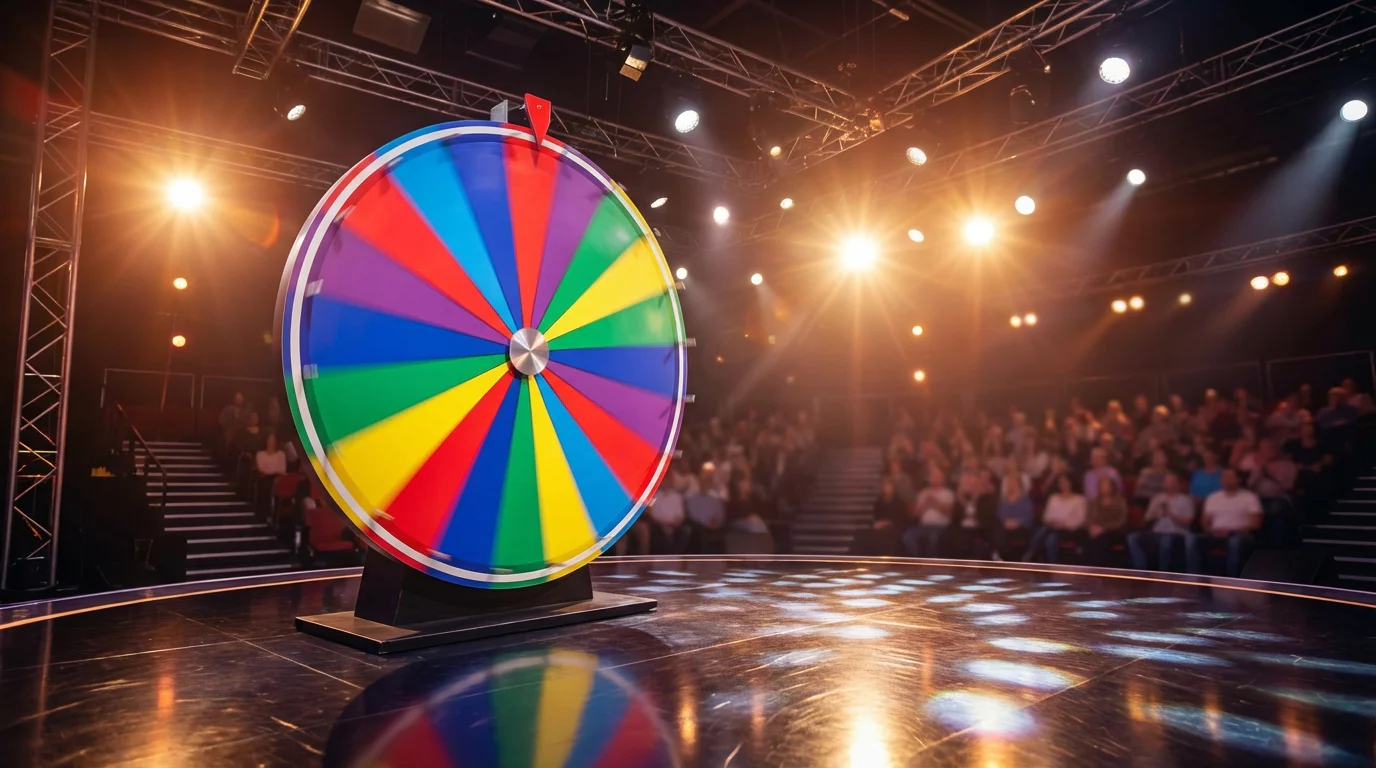
Live Game Shows — Where Gambling Meets Television
Live game shows are the most recent category to establish itself in online casino lobbies, and they’ve done so by solving a problem that traditional casino games never addressed: entertainment beyond the bet itself. A roulette wheel is mechanically interesting for about five minutes. A slot provides visual stimulation but no social dimension. Live game shows — hosted by presenters in television-quality studios, with interactive bonus rounds, dramatic reveals, and multiplier mechanics — create an experience that feels closer to watching a game show than to sitting at a casino table.
Evolution created the category with Dream Catcher in 2017 and has dominated it since. The format works because it collapses the barrier between gambling and entertainment into a single product. You’re watching a host spin a wheel, or open boxes, or navigate a board game, with real money riding on each outcome. The production values — multi-camera studio setups, professional presenters, real-time audience interaction — are expensive to produce and impossible for competitors to replicate cheaply. That production cost is the moat around Evolution’s game-show business, and it’s why their titles appear at virtually every non-GamStop casino with a live dealer lobby.
At non-GamStop casinos, game shows are available without the UKGC’s responsible gambling overlays — no mandatory reality checks interrupting the show, no affordability triggers pausing play, and no restricted session timers. The games run continuously, 24 hours a day, with new rounds every 30 to 90 seconds depending on the format. For players who enjoy the game-show experience, the offshore environment provides uninterrupted access to the full catalogue. For players susceptible to extended play, the absence of mandatory breaks removes a protective mechanism that the format’s engaging nature makes particularly relevant.
Our top casino picks for the UK
- WinBeastBonus: €5000 + 500 FS + €650 Freebet · Payout speed: 1-3 business days
- EvoSpinBonus: 125% up to €2500 + 125 Free Spins · Payout speed: 1-3 business days
- SlotoSportBonus: 500% up to £ 10 200+ 777 FS · Payout speed: 1-3 business days
- JetsetspinsBonus: 200% Bonus + 100 Free Spins + Free Royal Wheel · Payout speed: 1-3 business days
- AmunbetBonus: Join now and get 450% up to 2,700 GBP + 450 FS · Payout speed: 1-3 business days
- DieselwinBonus: Welcome Pack 250% up to £4000 + 200 FS · Payout speed: 1-3 business days
- NightLuckBonus: Welcome Pack + 805% Up To 6400€ + 280 FS · Payout speed: 1-3 business days
- BritsinoBonus: Welcome Package – Get your £2,200 + 2,000 FS · Payout speed: 1-3 business days
- ZombillionBonus: Welcome Pack 250% up to £4000 + 200 FS · Payout speed: 1-3 business days
- Revery PlayBonus: 100% up to€1,000+ 100 FS · Payout speed: 1-3 business days
Best Live Game Shows at Non-GamStop Casinos
Crazy Time is Evolution’s flagship game show and the most-played title in the category globally. The game centres on a large spinning wheel divided into segments marked with numbers (1, 2, 5, 10) and four bonus games: Coin Flip, Cash Hunt, Pachinko, and Crazy Time. Players bet on which segment the wheel will land on. Number segments pay their face value as a multiplier. Bonus segments trigger interactive rounds with multiplier potential reaching 25,000x. A random “top slot” multiplier spins before each round, potentially multiplying the outcome of any segment. The presentation is maximalist — bright colours, energetic hosts, crowd reactions, and dramatic camera angles. The house edge averages approximately 4.6% across all bet types.
Monopoly Live combines the Monopoly board game with a live money wheel. The wheel includes number segments and bonus segments that trigger a 3D-rendered Monopoly board game. When the bonus activates, a virtual Mr Monopoly walks around the board, collecting multipliers and building houses and hotels that increase payout values. The integration of an iconic board game brand with live gambling creates a uniquely nostalgic entertainment product. The house edge ranges from approximately 3.7% to 7.7% depending on which segments you bet on, with the bonus bets carrying higher edges.
Dream Catcher is the original Evolution game show and remains the simplest. A vertical money wheel with segments marked 1, 2, 5, 10, 20, and 40, plus two multiplier segments (2x and 7x) that double or septuple the next winning result. The format is pure wheel-of-fortune mechanics with no interactive bonus rounds. The house edge ranges from approximately 3.4% on the “1” segment to 7.7% on the “40” segment. Dream Catcher serves as an accessible entry point for players who want the game-show experience without the complexity of Crazy Time’s multi-layered bonus structure.
Funky Time is Evolution’s latest major game-show release, combining a large vertical wheel with four distinct bonus games: Bar, Stayin’ Alive, Disco, and VIP Disco. Each bonus has its own mechanic and multiplier structure, with the VIP Disco offering the highest potential payouts. The production design leans heavily into 1970s disco aesthetics with elaborate set design and costumed hosts. Mechanically, Funky Time expands on Crazy Time’s formula with more bonus variety and higher maximum multipliers. The house edge is approximately 4.0% to 6.0% across different bet types.
Lightning Dice and Lightning Ball by Evolution round out the category with simpler formats. Lightning Dice uses three dice dropped through a tower, with random multipliers applied to specific totals before each round. Lightning Ball combines a ball draw with a bingo-style grid and multiplier mechanics. Both have lower production overhead than the full game shows but carry the Lightning brand’s multiplier appeal. House edges vary by bet type but generally sit between 2.8% and 5.0%.
How Each Format Works and What It Actually Costs
| Game | Round Duration | House Edge Range | Max Multiplier | Complexity |
|---|---|---|---|---|
| Crazy Time | 45–90 seconds | 4.0–5.3% | 25,000x | High |
| Monopoly Live | 60–120 seconds | 3.7–7.7% | 10,000x+ | Medium-High |
| Dream Catcher | 40–60 seconds | 3.4–7.7% | 280x | Low |
| Funky Time | 50–100 seconds | 4.0–6.0% | 10,000x+ | High |
| Lightning Dice | 30–50 seconds | 2.8–3.7% | 1,000x | Low |
The house edge across game-show formats is generally higher than traditional table games but comparable to or lower than many slot categories. Crazy Time’s average 4.6% edge is lower than most medium-volatility slots (which typically carry 3–6% edges) and substantially lower than progressive jackpot slots (where effective RTPs often fall below 90%). The difference is that game shows deliver their house edge through a social, visually engaging format that feels less like a gambling session and more like participating in a television production.
The cost per hour of game-show play depends on bet size and round frequency. At £1 per bet on Crazy Time with one round per minute, you wager approximately £60 per hour. At a 4.6% house edge, the expected loss is £2.76 per hour — one of the lowest hourly costs in the casino for a continuously running live game. Increasing to £5 per bet raises the expected hourly cost to £13.80. The pace is important: game shows run slower than RNG games but faster than most traditional live tables, creating a comfortable rhythm that sustains engagement without the rapid-fire pacing of slots or crash games.
Bet selection within each game significantly affects the house edge. In Dream Catcher, the “1” segment has a 3.4% edge while the “40” segment has a 7.7% edge. In Monopoly Live, number bets carry lower edges than bonus bets. The general pattern across all game-show formats is that conservative bets (lower-paying, higher-probability segments) carry lower house edges, while speculative bets (bonus rounds, high-value segments) carry higher ones. The casino subsidises the exciting outcomes — the big multipliers, the bonus games — by charging a premium on the bets that access them.
Entertainment Is the Product — The House Edge Is the Price
Game shows make gambling feel like television — but the house edge is real. The production quality, the charismatic hosts, the dramatic bonus rounds all serve a purpose beyond entertainment: they sustain engagement. A player who would leave a roulette table after twenty minutes might stay at Crazy Time for two hours because the experience is more enjoyable. That extended engagement means more bets, more exposure to the house edge, and more revenue for the casino — earned not through aggressive mechanics but through a product that people genuinely want to keep watching.
That engagement model is neither deceptive nor unique to gambling — every entertainment business is designed to hold attention. The difference is that in a casino game show, every minute of attention costs money. The production values that make the experience feel like free entertainment are funded by the house edge on every bet you place. Understanding that relationship is the foundation for enjoying game shows responsibly: budget for the entertainment, not for the outcome.
At non-GamStop casinos, where game shows run without mandatory session limits or reality checks, the player’s awareness of time and spending is the only brake on play duration. Set a session budget before joining a game show. Track your time as actively as your balance — the format is designed to make two hours feel like thirty minutes, and that temporal distortion is the most subtle and effective mechanism for increasing total wagering. The game shows themselves are among the most entertaining products in any casino lobby. Treating them as entertainment with a defined budget turns that entertainment value into what it should be: an experience worth paying for, on terms you’ve set in advance.
Visit bestnongstopcasinos for the best non-GamStop casino reviews and guides.
Learn how crash games work in our Crash Games guide.